
Dry Rot Treatment in Birmingham (Cause Found, Sound Timber Kept Where Possible)
Dry Rot and Wet Rot Treatment in Birmingham: protect your property value by finding the damp source first, then fixing timber. Written quote before any work.
Call for a damp survey on 0121 330 2385. Open 7 days, 9am to 7pm. Eco Damp Proofers is a local team covering Birmingham and the West Midlands. We find out why timber is rotting before we recommend any work, because dry rot treatment in Birmingham only works if the moisture is dealt with first.
When Timber Starts to Decay
Rot in floorboards, joists, skirting or roof timbers is a fungal problem, and fungi need damp wood to survive. Take away the moisture and the fungus has nothing to live on. That is why a good repair starts with a leaking gutter, a failed pointing joint or a blocked airbrick rather than with chemicals.
Birmingham’s weather does not help. The Met Office records about 133 days a year with 1 mm of rain or more at the University of Birmingham site (1991-2020 averages), so any weak point in a roof, wall or drain gets tested regularly. Older Victorian and Edwardian terraces in Erdington, Handsworth and Moseley, interwar semis in Sutton Coldfield and Solihull, and post-war flats in Walsall all have their own typical trouble spots.
If you have spotted crumbling timber, a musty smell under the stairs or a floor that bounces, call us. Often the answer is smaller than you fear.
Dry Rot or Wet Rot: How to Tell
Dry rot and wet rot are different fungi with different habits. Wet rot stays where the timber is wet. Dry rot can spread beyond the damp patch, so it needs a wider, more careful response. Telling them apart matters because it changes how much needs to be opened up and replaced.
Wet rot usually shows as dark, soft timber that feels spongy, often with cracking along the grain. It tends to stay in the area that is actually wet, such as a window sill, a joist end by a leaking pipe or a fascia under a broken gutter.
Dry rot is more serious. Typical signs include deep cuboidal cracking (timber breaking into brick-like blocks), a grey-white fungal skin, a mushroom smell, and rusty-red spore dust. It can travel behind plaster and across masonry, so rot can appear some distance from the original leak.
We inspect the timber, probe it, check moisture levels and look at the surrounding structure. Where we cannot be sure by eye, we say so, and we may suggest a laboratory sample. This is for homeowners who have found a soft floor or a strange smell, and for buyers whose survey has flagged “timber decay” without saying what kind. You get a plain answer on what you have and how far it goes.
Finding and Stopping the Moisture Source
Rot will return unless the water feeding it is stopped. We trace the moisture before quoting for any timber work. This is the step many firms rush, and it is where we spend most of our time.
We work through the usual suspects in order:
- Gutters and downpipes: blocked, leaking or misaligned gutters soak walls and roof timbers.
- Pointing and brickwork: eroded mortar lets rain through, particularly on exposed gable ends.
- Ground levels: paths, patios or soil built up above the damp-proof course push moisture into walls, a point covered by Building Regulations Approved Document C (resistance to moisture).
- Ventilation: blocked airbricks or sealed-up underfloor voids leave timber permanently damp. Approved Document F covers ventilation in general.
- Plumbing and roofs: slow leaks from pipes, missing tiles and failed flashings.
- Condensation: in some homes poor ventilation is the whole story.
Sometimes fixing a gutter or clearing an airbrick is all that is needed, and we will tell you plainly if that is the case. When the cause is more involved, such as a failed damp-proof course or a drainage fault, we explain it and quote for it separately. You benefit because the repair lasts, and because you only pay for work that addresses the real cause.
Cutting Out and Replacing Timber
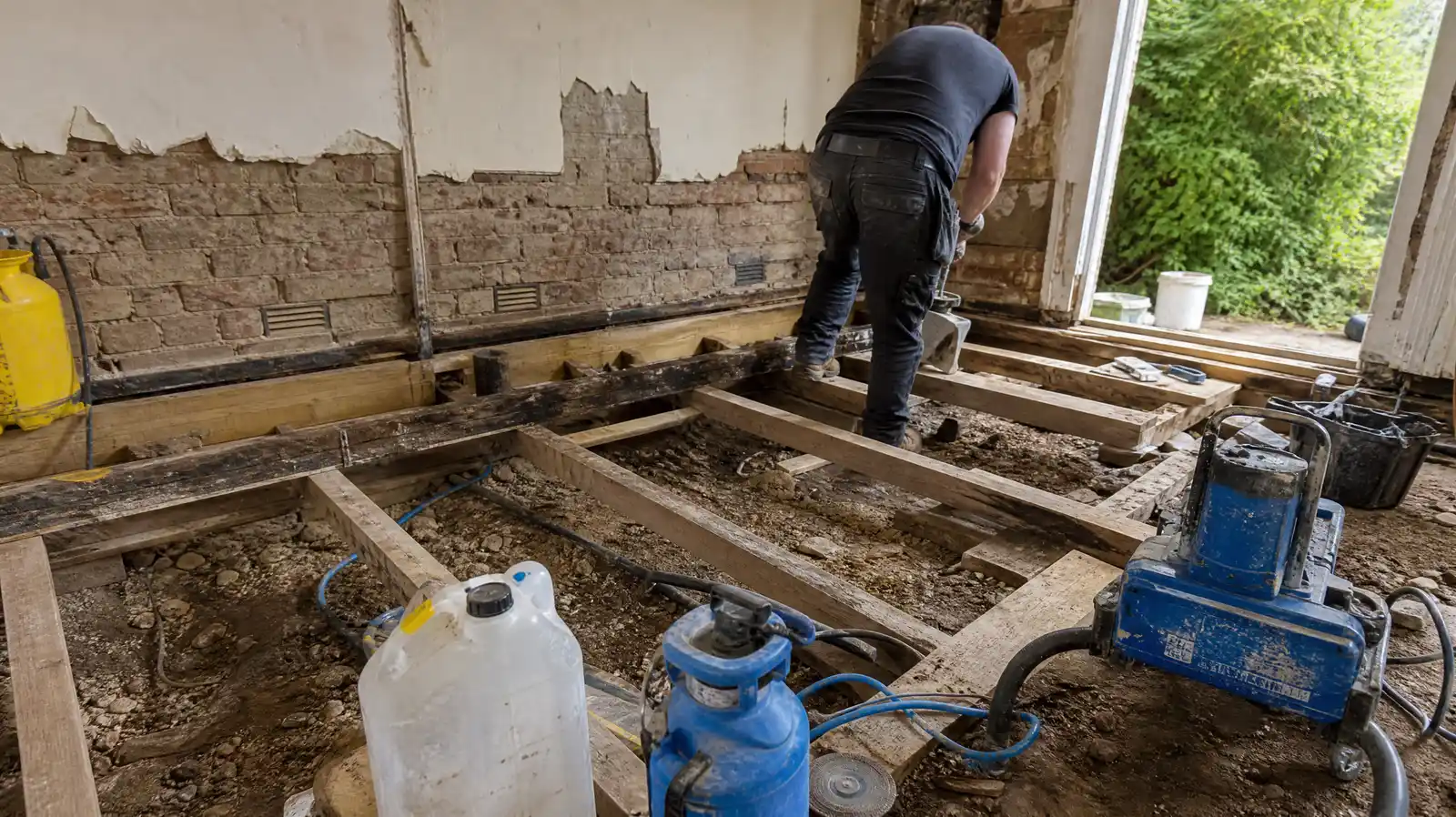
Where rot has weakened timber, the damaged section is cut out and replaced with treated, sound timber. We aim to remove only what has to go. Not every affected board or joist needs ripping out. Surface staining or minor decay in a large beam may be treatable in place once it is dry.
For wet rot, repair is usually local. We cut back to sound wood, replace the affected length and treat the surrounding timber. Joist ends can often be repaired rather than replaced completely, which keeps cost and disruption down.
Dry rot calls for more care. We remove decayed timber, check adjoining walls and joinery, and treat masonry where the fungus may have spread. Everything removed is bagged and disposed of properly so spores are not carried through the house.
Replacement timber is properly treated and, where it meets masonry, isolated from damp. Following Property Care Association guidance on good practice helps to keep the work to a recognised standard. Afterwards the room can be finished again, with new boards, plaster and decoration.
This is for homeowners with confirmed decay in floors, roof timbers, joinery or structural beams. The benefit is a sound, safe structure without replacing more than necessary.
Who Usually Needs This
- Owners of older terraces and semis, especially with suspended timber floors and cellars or cavities that cannot breathe.
- Buyers with a survey that mentions rot, who need to know whether it is a negotiating point or a walk-away.
- Landlords dealing with a tenant complaint about damp, soft floors or mould.
- Owners of properties with long-term leaks, such as a neglected roof valley or a failing bay window.
According to the English Housing Survey 2024 to 2025 headline report (MHCLG), 1.4 million homes in England (5%) had a problem with damp in 2024. Rot is what damp can leave behind if it is ignored.
Landlords, Tenants and Awaab’s Law
Since 27 October 2025, Awaab’s Law requires social landlords in England to investigate significant damp and mould hazards within 10 working days, send a written summary within 3 working days of the investigation, and complete safety works within 5 working days. Emergency hazards must be dealt with within 24 hours (GOV.UK, Awaab’s Law guidance for social landlords, MHCLG, 2025).
Private landlords are not covered by that timetable, but the Housing Health and Safety Rating System (HHSRS) treats damp and mould growth as a hazard, and councils can act on it. If a tenant reports soft floors, fungal growth or persistent damp, investigate promptly and keep records. We can survey, explain the cause in writing and quote for the repair.
From Survey to Completion
- Call and talk it through. Ring 0121 330 2385 and describe what you can see. We will tell you if it sounds urgent.
- Inspection. We look at the timber, check moisture and trace where the water is coming from.
- Written findings and quote. You get the cause, what needs doing and why, with cheaper options included where they exist. Nothing starts until you have it in writing.
- Fix the source. Roofline, drainage, pointing, ground levels or ventilation are put right first.
- Timber repair. Decayed timber is cut out and replaced, and surrounding wood and masonry are treated where needed.
- Handover. We explain what was found and what to watch, so you can spot any change early.
What You’ll Gain
- A structure you can trust, with sound timber under your feet and over your head.
- Peace of mind when selling or buying, because a documented cause and repair is easier to explain to a surveyor or lender than an unexplained patch.
- No unnecessary work. Cause-first diagnosis means you are not paying for treatments the building does not need.
- A drier, healthier home. Children, older people, people with existing health conditions and people with weakened immune systems are at greater risk from damp and mould (GOV.UK, MHCLG and UKHSA), so fixing the moisture is worth doing promptly.
What Affects the Price
Costs depend on how far the decay has spread, how easy it is to reach, how much timber is involved, and what has to be repaired first. Checkatrade’s damp proofing cost guide (2026) says price also depends on the type and severity of the damp, the treatment method, the size of the affected area, access and the property’s location.
For reference, Checkatrade’s dry rot repair cost guide (2026) puts the average cost to fix dry rot at £4,603, with structural wood rot repair typically costing £4,000 to £12,000. Those are national guide figures, not our quote. A small wet rot repair at a window sill will be far lower, and a major dry rot outbreak affecting several rooms will sit higher.
Checkatrade’s damp proofing cost guide (2026) puts a damp survey at around £300. Call us for what our inspection involves and costs. Timescales vary with the extent of the work, and we will give you an honest estimate in the written quote.
Common Questions
How much does dry rot treatment cost in Birmingham?
It depends on how far the decay has spread. Checkatrade’s dry rot repair cost guide (2026) gives an average of £4,603 for dry rot and £4,000 to £12,000 for structural wood rot repair. Small, localised jobs cost much less. We give a written quote after inspection, with cheaper options where they exist.
Do I need to replaster after dry rot treatment?
Often some replastering is needed where walls were opened up to check for fungal spread, but not always. If the affected area is limited and the masonry is sound, we keep plaster removal to a minimum. We tell you in the written quote what is included and what finishing you may need to arrange.
Will rot stop me selling or getting a mortgage?
Not necessarily. Lenders and buyers mainly want to know the cause has been found, fixed and documented. Unexplained or untreated decay is what causes problems. A clear written record of the diagnosis and repair puts you in a stronger position, although individual lenders make their own decisions.
Who is responsible for rot in a rented home?
Landlords are generally responsible for repairing the structure, including damp-related timber decay. Social landlords in England must meet Awaab’s Law timescales for significant damp and mould hazards (GOV.UK, 2025). Tenants should report problems in writing, and landlords should investigate quickly and keep records of the cause and repair.
Does house insurance cover dry rot or wet rot?
Often not, because most policies exclude gradual deterioration. Cover may apply if the rot results from a sudden insured event, such as a burst pipe, so check your policy wording. If you plan to claim, keep photographs and a written report on the cause. We can provide findings in writing.
Talk to Someone Local
If you have soft timber, a musty smell or a survey that mentions rot, speak to us before you accept any quote. Call for a damp survey on 0121 330 2385, open 7 days a week, 9am to 7pm. We will find the cause, explain it plainly and give you a written quote before any work starts.


How It Works
From initial survey to completion — here’s what to expect when you work with us.
-
Call or send a message
Tell us what you can see. We ask a few questions and book a visit at a time that suits you, any day 9am–7pm.
-
We find the cause
We check inside and out: readings across the walls, gutters, pointing, ground levels, ventilation and timbers.
-
Written quote
You get the cause, the fix and the price in writing, including any cheaper options, before any work starts.
-
We do the work
Our own team carries out the treatment, leaves the house tidy and explains how long the walls need to dry.
Related Guides
Helpful articles to learn more about this service.
Damp, mould or a musty smell? Let's find the cause.
Call us 7 days a week, 9am–7pm. We can usually do a free survey within 3 working days, find what's really causing it, and give you a written quote before any work starts.