
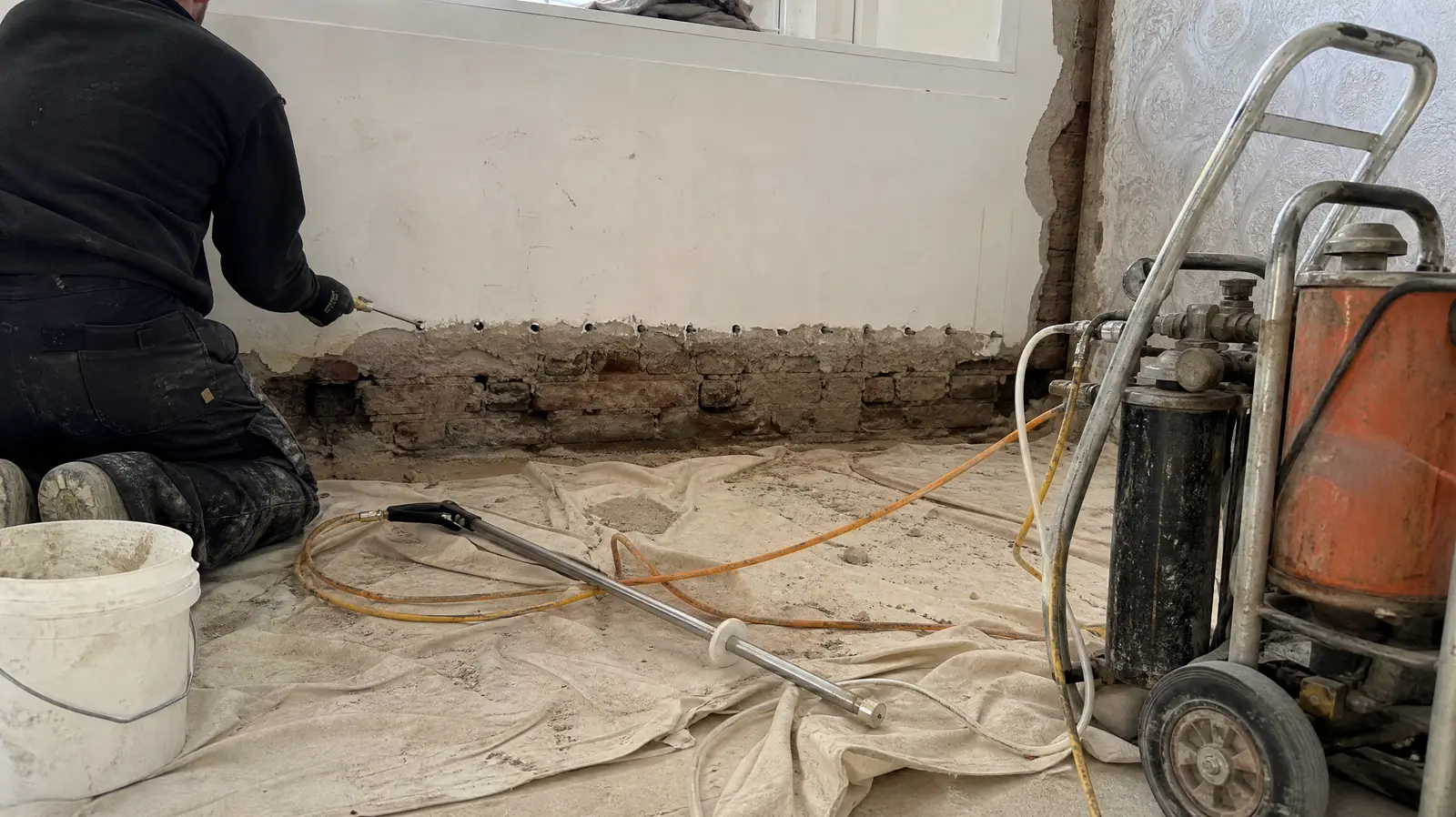
Penetrating Damp Treatment in Birmingham (Find the Leak, Fix the Cause)
Penetrating Damp Treatment in Birmingham: fix the cause, protect your property value and keep walls dry. Local team. Written quote before any work.
Call 0121 330 2385 to book a damp survey. Call for a damp survey
Open 7 days a week, 9am–7pm. Covering Birmingham and the West Midlands.
Our promise: we find where the water is getting in before we recommend any treatment.
If damp patches appear on your walls after rain, the cause is usually outside, not in the wall itself. Eco Damp Proofers is a local team that looks for the entry point first: a failed gutter, tired pointing, a cracked render or a blocked chimney flashing. Penetrating damp treatment in Birmingham often costs far less than people expect, because the fix is frequently a repair rather than a chemical treatment. Birmingham sees rain of 1 mm or more on about 133 days a year (Met Office, 1991–2020 averages), so any weakness in your outer walls gets tested regularly.
Understanding the Process
Penetrating damp, sometimes called lateral damp, is water moving sideways through a wall from outside to in. It differs from rising damp, which travels up from the ground, and from condensation, which forms on cold surfaces inside.
Walls are built to shed most rain and dry out between showers. Problems start when something lets water collect or soak in: a leaking downpipe, crumbling mortar, a cracked render, a damaged chimney or a gap around a window. The wall stays wet for days, and the damp eventually shows on the inside.
In the English Housing Survey 2024 to 2025 (MHCLG), penetrating damp affected 2% of English homes, against 3% for serious condensation and 1% for rising damp. So it is common enough to expect, and often mistaken for something else.
Who Needs This
- Owners of Victorian and Edwardian terraces in Erdington, Handsworth and Moseley, where solid brick walls take in rainwater when pointing wears.
- Interwar semis in Sutton Coldfield and Solihull, where render cracks and cavity walls can let water through.
- Post-war flats, where leaking gutters and failed sealants above a flat are common culprits.
- Landlords dealing with a tenant’s damp complaint who need the cause identified properly.
- Buyers whose survey flagged damp and who want to know if it is minor or serious.
Common Causes on Birmingham Brickwork
Much of Birmingham’s older housing is solid brick, which absorbs and releases moisture rather than blocking it. That works well until something upsets the balance.
The usual suspects we find across Erdington, Walsall and the wider area are:
- Pointing that has eroded or been replaced with hard cement, which can force water into the softer brick.
- Cracked or blown render that lets rain behind it.
- Gutters and downpipes that leak, overflow or discharge against the wall.
- Ground or paths built up above the damp-proof course, so splashing rain reaches the brick.
- Gaps around windows and doors.
- Failed chimney flashing and cracked stacks.
For you, the benefit is clarity. Once the true entry point is identified, you can fix it once rather than repeatedly redecorating over a stain that returns.
Repointing, Gutters and Render Repairs
This is where most penetrating damp is solved, and where we begin.
Gutters and downpipes. Clearing, realigning or replacing a leaking section stops water running down the wall face. It is the cheapest fix and often the most effective.
Repointing. Where mortar has crumbled, we rake out the loose material and repoint with a mix suited to the brick. Older homes generally need a softer lime-based mortar rather than hard cement, which can trap moisture and damage the bricks.
Render repairs. Cracked or hollow render lets water in and holds it there. Patching small areas or replacing failed sections restores the wall’s protection.
This work suits homeowners with visible defects outside, and landlords wanting a lasting repair. The benefit is a wall that sheds water properly, with no need for chemical treatment.
Masonry Water-Repellent Treatment
A water-repellent treatment is a clear, breathable liquid applied to sound brickwork. It causes rain to bead and run off instead of soaking in, while still letting the wall breathe.
It is not a cure for a leaking gutter or crumbling mortar, and we will not apply it over defects. It suits walls that are in good repair but still take in water, such as exposed gables and elevations facing the prevailing weather, particularly on solid brick homes.
Done after repairs, it can reduce how much rain the wall absorbs. The benefit is added protection with no change to the look of your brickwork. We will say honestly if your walls do not need it, and we quote it separately so you can decide.
Chimney and Bay Window Damp
Chimneys and bay windows are two of the most frequent sources of damp patches after rain in Birmingham’s older homes.
Chimneys. Stacks are exposed on every side. Failed flashing, cracked pots, loose pointing or a missing cap lets water into the breast, often showing as brown staining or damp wallpaper in the bedroom or living room. We check the stack, flashing and pointing, and repair what is faulty. Unused flues often benefit from ventilation, which helps them stay dry.
Bay windows. Bays have small flat roofs, lead or felt joints, and many junctions where water can enter. Damp often shows around the window head or in the corners. We inspect the roof covering, seals and surrounding brickwork.
The benefit is finding a localised fault and fixing it, rather than treating a whole wall that was never the problem.
From Survey to Completion
- Call and talk it through. Ring 0121 330 2385 and describe where and when the damp appears.
- Survey inside and out. We check gutters, pointing, render, roof edges, ground levels, chimneys and windows, and test the damp inside with a moisture meter.
- Rule out other causes. We consider condensation and rising damp before settling on penetrating damp, following the approach in BS 6576:2005 for diagnosing rising damp.
- Written quote. You receive a written quote before any work starts, with cheaper options included where they exist.
- Repair the entry point. We fix the gutter, pointing, render or flashing, and apply water-repellent treatment only if it is needed.
- Dry-out and check. Walls take time to dry. We advise on when to redecorate and replaster, if needed.
What You’ll Gain
- A fix that lasts, because the cause is dealt with at source.
- Lower costs, since repairs often replace more extensive treatment.
- A drier, more comfortable home, with less risk of mould returning.
- Better protection for your brickwork, particularly with correct lime-based repointing.
- Confidence when selling or letting, with a documented cause and repair.
Homes with uninsulated walls make up 47% of English homes, and 8% of them have a damp problem (English Housing Survey 2023 to 2024, MHCLG), so well-kept external walls matter.
Investment Guide
Price depends on the type and severity of the damp, the treatment method, the size of the affected area, access and the property’s location (Checkatrade damp proofing cost guide, 2026).
For context, damp proofing in the UK averages £1,220, with typical jobs from £772 to £1,942 (Checkatrade damp proofers in the United Kingdom, 2026). In Hall Green, Birmingham, the average is £1,104 (Checkatrade damp proofers in Hall Green, 2026). A damp survey costs around £300 (Checkatrade damp proofing cost guide, 2026). These are general damp proofing figures rather than quotes for penetrating damp specifically.
Repairing a gutter or a short run of pointing is usually a smaller job than full-scale damp proofing. Your written quote will set out each option and its cost. Timescales depend on access and weather, and we will give you a realistic estimate after the survey.
Landlords: Awaab’s Law and Your Duties
Since 27 October 2025, Awaab’s Law requires social landlords in England to investigate significant damp and mould hazards within 10 working days, send a written summary within 3 working days of the investigation, and complete safety works within 5 working days. Emergency hazards must be dealt with within 24 hours (GOV.UK, Awaab’s Law guidance for social landlords, MHCLG, 2025).
Private landlords are not covered by the same timeframes, but the Housing Health and Safety Rating System (HHSRS) still treats damp and mould as a hazard. In the English Housing Survey 2024 to 2025 (MHCLG), damp affected 10% of privately rented homes and 7% of social rented homes, so complaints are common. Children, older people and those with health conditions are at greater risk (GOV.UK, MHCLG and UKHSA). A prompt, documented diagnosis protects both tenant and landlord.
Book Your Survey
If you have damp patches after rain, or a survey has flagged damp, speak to a local team who will look for the cause before recommending any work. Call 0121 330 2385 any day between 9am and 7pm. Call for a damp survey


How It Works
From initial survey to completion — here’s what to expect when you work with us.
-
Call or send a message
Tell us what you can see. We ask a few questions and book a visit at a time that suits you, any day 9am–7pm.
-
We find the cause
We check inside and out: readings across the walls, gutters, pointing, ground levels, ventilation and timbers.
-
Written quote
You get the cause, the fix and the price in writing, including any cheaper options, before any work starts.
-
We do the work
Our own team carries out the treatment, leaves the house tidy and explains how long the walls need to dry.
Related Guides
Helpful articles to learn more about this service.
Frequently Asked Questions
Penetrating damp usually appears as patches that darken after rain and dry out in spells of dry weather. It often sits near a window, chimney breast or below a leaking gutter. Rising damp stays low on the wall, and condensation forms on cold surfaces. A survey confirms which one you have.
It can be, if left. Persistent water can damage plaster, timber and brickwork, and encourage mould. But it is usually fixable once the entry point is found. Quick action generally means simpler repairs and a smaller bill.
Not always. Once the wall dries, light staining may only need redecorating. Plaster that is crumbling, salt-contaminated or blown usually needs replacing. We check this at survey, and the quote shows what is needed.
It depends on the cause. A gutter repair costs less than render or chimney work. Damp proofing in the UK averages £1,220 (Checkatrade damp proofers in the United Kingdom, 2026), but your written quote reflects your property.
No. Injection treats rising damp from the ground, not water coming through the wall from outside. For penetrating damp, the answer lies in repairing gutters, pointing, render or flashing. We will tell you plainly if injection is not needed.
Damp, mould or a musty smell? Let's find the cause.
Call us 7 days a week, 9am–7pm. We can usually do a free survey within 3 working days, find what's really causing it, and give you a written quote before any work starts.