
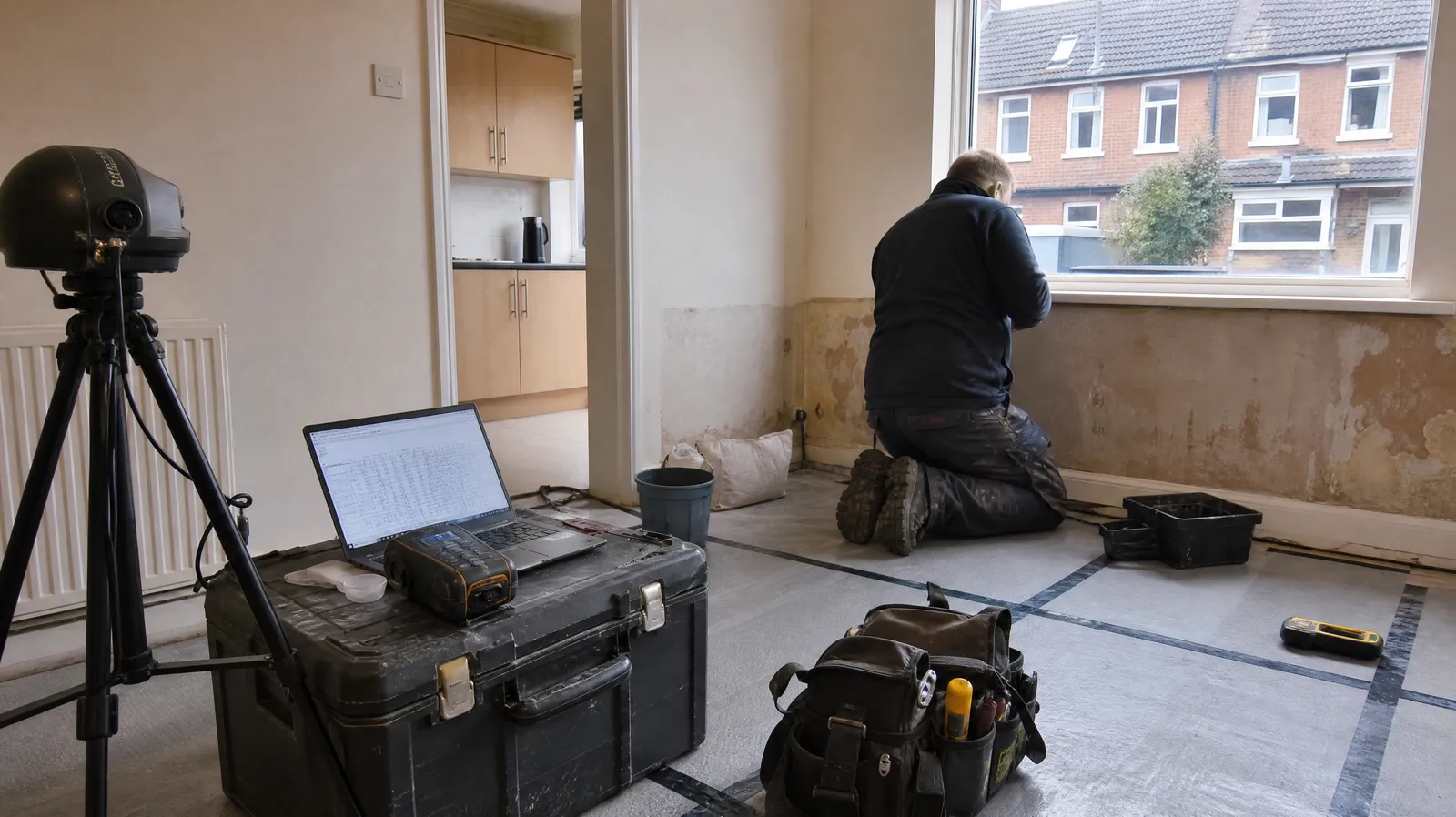
Damp Survey in Birmingham (Find the Real Cause Before You Pay for a Fix)
Damp Survey in Birmingham from a local team. Find the real cause, protect your property value and avoid needless work. Written quote before any work.
Call for a damp survey: 0121 330 2385
Open 7 days a week, 9am-7pm. Covering Birmingham and the West Midlands. We find the cause first, whether that’s gutters, pointing, ground levels or ventilation, before we suggest any treatment.
If you want a damp survey in Birmingham, you probably want two things: the real cause, and no sales pitch. Eco Damp Proofers is a local team that inspects damp cause first and treats only what needs treating. Birmingham’s older homes are hard on masonry. The Met Office records about 809 mm of rain a year at Winterbourne, with rain on about 133 days (Met Office, 1991-2020 averages), so a blocked gutter or tired pointing can soak a wall for months. We work for homeowners, landlords and buyers whose survey has flagged damp across Erdington, Sutton Coldfield, Moseley, Handsworth, Solihull and Walsall. Call 0121 330 2385 and talk it through with us.
Understanding the Process
Damp has several causes that look alike. A brown patch on a wall might be rising damp, rain getting through the brickwork, a leaking pipe or condensation. Treating the wrong one wastes money and the stain comes back.
Government figures show how often the cause is not what people assume. Serious condensation was the most common form of damp in English homes in 2024 (3%), ahead of penetrating damp (2%) and rising damp (1%) (English Housing Survey 2024 to 2025, MHCLG). Rising damp is real, but it is less common than its reputation.
So we diagnose before we recommend. BS 6576:2005 sets out how rising damp should be diagnosed, and we follow that thinking: rule out the simpler causes, then confirm what is left.
What We Check Inside and Out
A proper inspection starts outside, because most damp starts there. We look at gutters, downpipes and hoppers for blockages, leaks and overflow staining. We check pointing and brickwork for gaps, cracks and failed repairs. We look at ground levels against the wall, since soil, paving or a raised patio sitting above the damp-proof course lets moisture bridge straight into the house. We also check for cement render holding water in older solid walls, and for airbricks that have been covered or blocked.
Inside, we use a moisture meter to map where the dampness is, how high it reaches and whether it follows a pattern. We look at salt contamination, plaster condition, skirting boards and floor edges. We check ventilation in kitchens, bathrooms and bedrooms against the principles in Building Regulations Approved Document F, and we look at roof spaces, chimney breasts and plumbing where relevant.
This is for anyone with a patch they can’t explain. The benefit is a clear picture of what is happening, rather than a guess based on one reading.
How We Decide It’s Really Rising Damp
Rising damp is the diagnosis we reach last, not first. We look for a tide-mark of ground salts, a consistent height of dampness along the wall, moisture that is highest at the base and fades upwards, and a damp-proof course that is missing or bridged. We also confirm that a leaking gutter, high ground or condensation doesn’t explain the pattern. If those checks point to rising damp, we say so and explain why. If they don’t, we tell you what they do point to.
When You Don’t Need Treatment
Many damp problems need a repair, not a treatment. We would rather fix a gutter than sell an injection you don’t need. In practice that often means:
- Clearing or replacing gutters and downpipes that are soaking a gable or chimney breast.
- Repointing failed mortar on a Victorian or Edwardian terrace.
- Lowering ground levels or clearing soil piled against a wall.
- Unblocking airbricks and improving ventilation in a post-war flat.
- Fixing condensation through extraction, heating habits and airflow, which a chemical damp-proof course will not cure.
This section matters most to buyers and landlords who have been told they need expensive work. If your wall just needs a gutter fixed, we’ll say so in writing, and you keep the money. If treatment is needed, you’ll know it is because the simpler causes have been ruled out.
What Your Written Report Includes
You get a written report you can keep, share with a lender or show a landlord or tenant. It sets out what we found and where, with the readings we took. It names the cause in plain English and explains how we reached that conclusion. It then lists the recommended work in order of priority, including cheaper options where they exist, and what we would leave alone. If plastering or redecoration will be needed afterwards, we tell you. The report also gives you a written quote before any work starts, so there is no pressure and no surprise.
This is for homeowners deciding what to do, buyers negotiating after a survey and landlords who need a record. The benefit is clarity: you can compare our findings with any other quote you receive.
Who Needs an Inspection
- Owners of Victorian and Edwardian terraces in areas such as Handsworth and Moseley, where solid walls and old pointing are common.
- Interwar semis in Erdington, Sutton Coldfield and Solihull, with their cavity walls and original airbricks.
- Post-war flats, where condensation and poor ventilation are frequent suspects.
- Buyers whose mortgage survey has flagged damp.
- Landlords dealing with a tenant’s complaint.
Landlords should know the rules. Damp affected 10% of privately rented homes and 7% of social rented homes in England in 2024, against 4% of owner-occupied homes (English Housing Survey 2024 to 2025, MHCLG). Since 27 October 2025, Awaab’s Law requires social landlords in England to investigate significant damp and mould hazards within 10 working days, send a written summary within 3 working days of the investigation, and complete safety works within 5 working days. Emergency hazards must be dealt with within 24 hours (GOV.UK, Awaab’s Law guidance for social landlords, 2025). Private landlords are still covered by the Housing Health and Safety Rating System, which treats damp and mould as a hazard. A dated written diagnosis helps either way.
Step by Step
- Phone call. Call 0121 330 2385 and tell us what you can see and where.
- Outside inspection. We check gutters, pointing, ground levels and airbricks first.
- Inside readings. We take moisture readings, check salts and plaster, and assess ventilation.
- Diagnosis. We explain the cause in plain language before you hear any price.
- Written report and quote. You receive both before any work starts, with cheaper options included where they exist.
What You Gain
You gain the right fix, not the most expensive one. You avoid paying for treatment that won’t work, and you get a record that supports a sale, a mortgage conversation or a tenancy discussion. Fixing the true cause also protects plaster and decoration from repeat damage. The report also helps you separate a one-off repair from a bigger job, so you can plan your spending.
Investment Guide
A damp survey typically costs £100-£600 (Checkatrade damp proofing cost guide, 2026). By property size, that is about £200 for a 2-bed flat, £400 for a 3-bed terraced house and £600 for a 4-bed detached house, and a PCA damp and timber survey costs £200-£600 (Checkatrade damp survey cost guide, 2023). Ask us for our own fee when you call, before you book.
If treatment follows, a chemical or injection damp-proofing job typically costs £1,000-£3,000 (Checkatrade damp proofing cost guide, 2026). Damp proofing in Hall Green, Birmingham averages £1,104 (Checkatrade damp proofers in Hall Green, 2026). Price depends on the type and severity of the damp, the treatment method, the size of the affected area, access and location (Checkatrade, 2026). The length of the visit depends on the size of the property and how many areas are affected.
Questions We Often Hear
How much does damp proofing cost in Birmingham?
Damp proofing in Hall Green, Birmingham averages £1,104 (Checkatrade damp proofers in Hall Green, 2026), and a chemical or injection job typically costs £1,000-£3,000 (Checkatrade damp proofing cost guide, 2026). The final price depends on the type and severity of the damp, the method, the area affected and access. You always get a written quote before work starts.
Is it rising damp or condensation?
Condensation usually shows as mould on cold walls, around windows and in corners, and it is worse in winter and in poorly ventilated rooms. Rising damp stays low, with a tide-mark, and does not respond to better airflow. Condensation was the most common damp type in England in 2024 (3%), ahead of rising damp (1%) (English Housing Survey 2024 to 2025, MHCLG). We check before we say.
Is a free damp survey worth it?
Yes, if it finds the real cause. Ours is free and there’s no obligation. We can usually visit within 3 working days, check outside as well as in, and explain the cause in plain English. If the fix is a gutter or better ventilation, we say so before quoting for anything bigger.
Who is responsible for damp in a rented home?
Usually the landlord is responsible for damp caused by the building, such as leaks, rain penetration or rising damp. Condensation can involve both landlord and tenant, depending on ventilation and living habits. Social landlords must meet Awaab’s Law timescales, including investigating significant hazards within 10 working days (GOV.UK, 2025). A written diagnosis helps settle the question fairly.
Will damp stop me selling or getting a mortgage?
Not necessarily. Lenders and buyers mainly want to know the cause and whether it has been dealt with. A written diagnosis showing that the problem is, say, a leaking gutter that has now been fixed can reassure them far more than an unexplained patch. Untreated damp can still affect the price you negotiate, so it is worth getting it checked early.
Talk to a Local Damp Specialist
Whether you are a homeowner, landlord or buyer, the quickest way to get a straight answer is to speak to us. We are open 7 days a week, 9am-7pm, and cover Birmingham and the West Midlands. Call for a damp survey on 0121 330 2385, and if the answer is a gutter, we will tell you.


How It Works
From initial survey to completion — here’s what to expect when you work with us.
-
Call or send a message
Tell us what you can see. We ask a few questions and book a visit at a time that suits you, any day 9am–7pm.
-
We find the cause
We check inside and out: readings across the walls, gutters, pointing, ground levels, ventilation and timbers.
-
Written quote
You get the cause, the fix and the price in writing, including any cheaper options, before any work starts.
-
We do the work
Our own team carries out the treatment, leaves the house tidy and explains how long the walls need to dry.
Related Guides
Helpful articles to learn more about this service.
Damp Survey Cost in Birmingham (2026): Free or Paid Survey?
Damp survey cost in Birmingham explained: typical prices, free vs independent surveys and what to ask before you book. A helpful Damp Survey guide.
Read guide →Is Rising Damp a Myth? What a Good Damp Survey Should Tell You
Is rising damp a myth? Learn how to spot genuine rising damp, what misdiagnosis looks like and what a good Damp Survey in Birmingham should tell you.
Read guide →Damp, mould or a musty smell? Let's find the cause.
Call us 7 days a week, 9am–7pm. We can usually do a free survey within 3 working days, find what's really causing it, and give you a written quote before any work starts.